


Biomimicry and Ultra-Low Doses
Biomimicry is an innovative approach that draws inspiration from nature’s solutions to design sustainable and effective strategies. In the field of medicine, it encourages the observation of natural regulatory and adaptive mechanisms in living organisms to better understand imbalances.
Biomimicry in Medicine
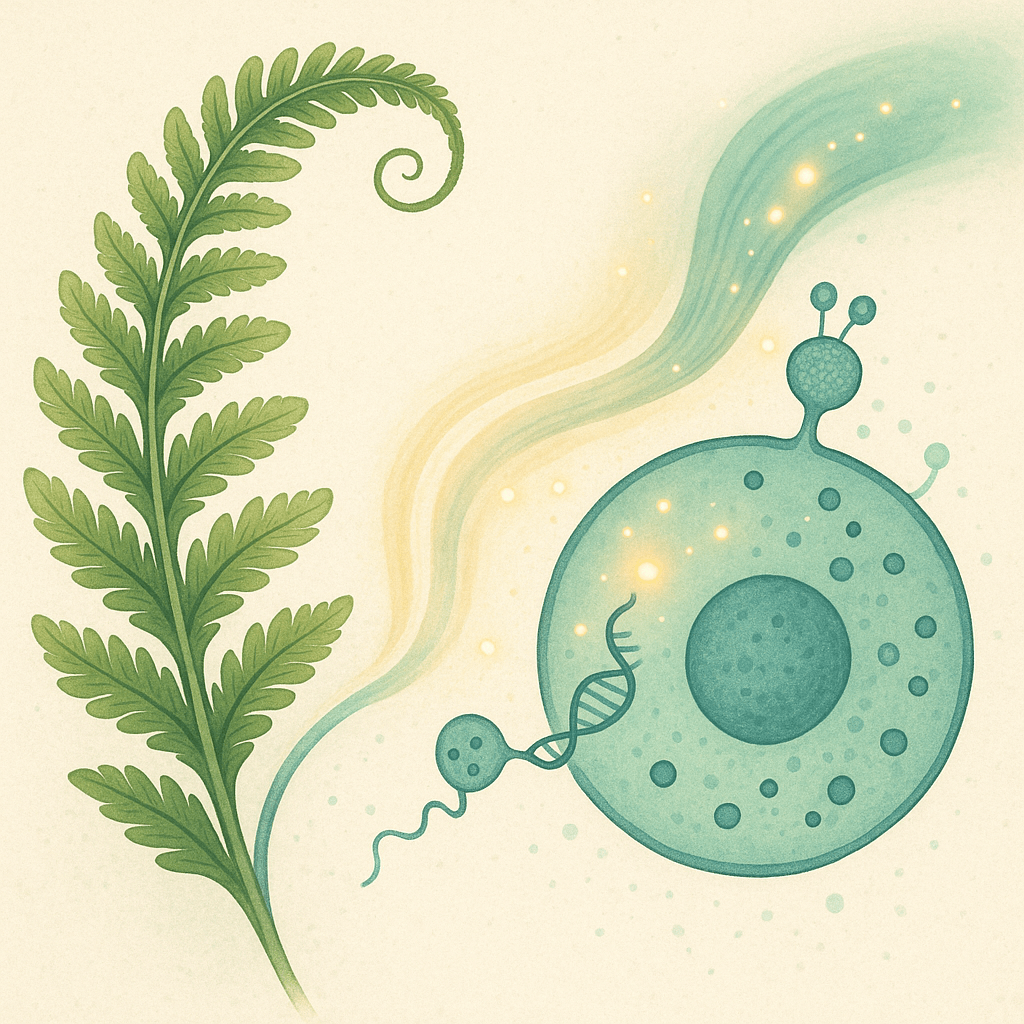
Bio Immuno(G)enetic Medicine draws inspiration from fundamental biological processes to restore immune balance. It relies in particular on non-coding RNAs, natural regulatory messengers.
This medicine of living organisms seeks to dialogue with the body rather than constrain it.
In this biomimetic approach, the use of ultra-low doses becomes highly relevant. Like the subtle signals that orchestrate cellular communication, these infinitesimal doses aim to finely modulate biological responses without forcing them. They are inspired by the natural concentrations of circulating non-coding RNAs, which are true orchestrators of immune and epigenetic regulation.
This life-respecting approach allows for precise action, by stimulating the body’s self-regulation capabilities.
What is an Ultra-Low Dose (ULD)?
ULDs refer to preparations where the concentration of the active principle is extremely low, sometimes beyond Avogadro’s number (i.e., without detectable molecules).
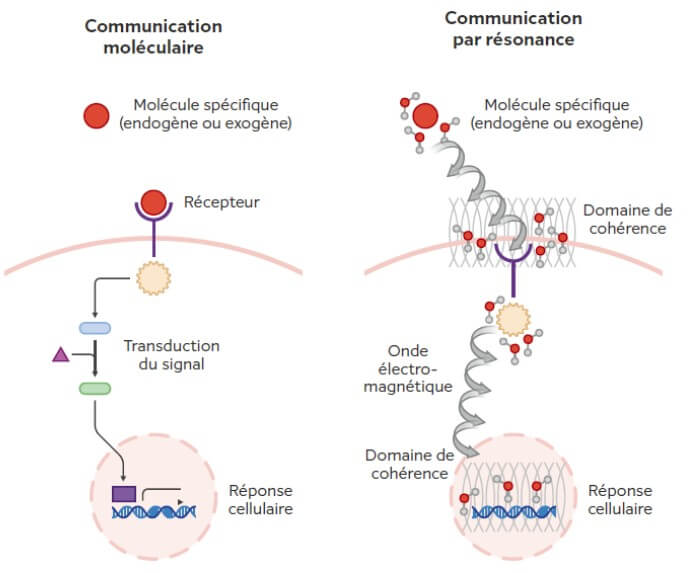
Unlike conventional treatments, their action is not based on a measurable quantity of substance, but on physical or informational signals. This logic aligns with a signal-driven dynamic rather than force, mirroring biological systems sensitive to minute stimuli.
This is the difference between molecular communication and resonance communication (inspired by this study).
A Life-Inspired Approach
Living organisms function through cellular communications based on weak signals: hormones, neurotransmitters, non-coding RNAs… All act at infinitesimal doses.
The use of ultra-low doses in medicine aligns with this biomimetic model: it is not about acting against a symptom, but about stimulating natural self-regulation processes, respecting the sensitivity of biological networks.
What Scientific Research Says
Numerous studies on the subject report:
- Measurable cellular effects of certain dilutions on gene expression, inflammation, or cell differentiation.
- Physical modifications of water (quantum coherence, structured domains) detectable by NMR, diffraction, or microscopy.
- The persistent presence of nanostructures or nanoparticles in highly dynamized dilutions.
- Field or clinical data reporting biological modulation (immune, inflammatory, neurological).
Proposed Mechanisms of Action
Current research suggests several complementary avenues:
- Law of hormesis: paradoxical effect of low doses stimulating adaptive mechanisms.
- Electromagnetic sensitivity: certain cells perceive signals carried by the environment or structured water.
- Water as an information carrier: formation of coherent domains or persistent nanometric structures capable of interacting with biological systems.
- Systemic approach: regulation via non-linear networks, where small impulses are sufficient to modify the global state.
Coherence with Bioimmunogenetic Medicine
Bioimmunogenetic medicine (BI(G)MED) uses non-coding RNAs at ultra-low doses to restart endogenous regulatory loops. This approach is based on the natural sensitivity of cells to circulating micro-messages.
The studies analyzed here reinforce the legitimacy of acting at these scales, based on a logic of resonance, fine-tuning, and modeling of living systems.
Responses to Common Misconceptions
“There’s nothing left in a high dilution.”
False: nanoparticles, structures, or physical signatures are often detectable.
“It’s too diluted to be active.”
In biology, certain hormones act at femtomolar concentrations (10⁻¹⁵ M), and the cell responds to them.
“It’s just water.”
Water is not inert; it can memorize, structure, and transmit information, particularly through coherent domains.
-
Cellular Self-Regulation and Homeostasis
Homeostasis is the body’s ability to adapt to environmental changes in order to maintain its internal balance. -
Epigenetics and Non-Coding RNAs
Epigenetics encompasses all processes that modify gene activity without changing the DNA sequence. -
What is Bio Immun(G)ene Medicine?
BI(G)MED stands for Bio-Immuno(G)enetic Medicine. This innovative medical approach aims to restore the natural self-regulation of cells.